多 Agent 编排
我们将使用1 个 Host Agent 通过 A2A 同时指挥 2 个 Remote Agent。
搭一个最小但完整的多 Agent 编排系统:Host Agent 发现两个远程 Agent(计算器 + 骰子),把用户请求拆成子任务并并行委派,最后汇总结果。
这是 A2A 最核心的应用形态,也是企业"Agent 团队"的雏形。
架构
                         用户请求
              "算 42*17,然后再掷一次 2d6"
                            │
                            ▼
                  ┌───────────────────┐
                  │    Host Agent     │ ① 读取两张 Agent Card
                  │   (编排者/Client) │ ② 按技能标签路由子任务
                  └─────┬───────┬─────┘ ③ asyncio 并行委派
                  A2A   │       │   A2A
            ┌───────────┘       └───────────┐
            ▼                               ▼
  ┌──────────────────┐            ┌──────────────────┐
  │ Calculator Agent │            │    Dice Agent    │
  │  localhost:10001 │            │  localhost:10002 │
  │  技能标签: math   │            │  技能标签: dice   │
  └──────────────────┘            └──────────────────┘
       (两个独立进程/服务,Host 不知道也不关心其内部实现)
Remote Agents 代码
创建一个remote_agents.py:
一个进程里用 uvicorn 同时起两个独立的 A2A Server(生产中它们通常是 不同团队、不同机器上的服务):
"""实战三:两个远程 Agent(计算器 + 骰子),供 Host Agent 委派任务。

运行: ./venv/bin/python remote_agents.py
  - Calculator Agent -> http://localhost:10001
  - Dice Agent       -> http://localhost:10002
"""

import asyncio
import random
import re

import uvicorn
from starlette.applications import Starlette

from a2a.server.agent_execution import AgentExecutor, RequestContext
from a2a.server.events import EventQueue
from a2a.server.request_handlers import DefaultRequestHandler
from a2a.server.routes import create_agent_card_routes, create_jsonrpc_routes
from a2a.server.tasks import InMemoryTaskStore, TaskUpdater
from a2a.types import (
    AgentCapabilities,
    AgentCard,
    AgentInterface,
    AgentSkill,
    Part,
    Task,
    TaskState,
    TaskStatus,
)


class BaseExecutor(AgentExecutor):
    """公共骨架:创建 Task -> working -> 业务逻辑 -> artifact -> completed"""

    def handle(self, user_text: str) -> str:  # 子类实现
        raise NotImplementedError

    async def execute(self, context: RequestContext, event_queue: EventQueue) -> None:
        if context.current_task is None:
            await event_queue.enqueue_event(
                Task(
                    id=context.task_id,
                    context_id=context.context_id,
                    status=TaskStatus(state=TaskState.TASK_STATE_SUBMITTED),
                    history=[context.message] if context.message else [],
                )
            )
        updater = TaskUpdater(event_queue, context.task_id, context.context_id)
        await updater.start_work()
        result = self.handle(context.get_user_input())
        await updater.add_artifact([Part(text=result)], name="result")
        await updater.complete()

    async def cancel(self, context: RequestContext, event_queue: EventQueue) -> None:
        await TaskUpdater(event_queue, context.task_id, context.context_id).cancel()


class CalcExecutor(BaseExecutor):
    def handle(self, user_text: str) -> str:
        m = re.search(r"(-?\d+(?:\.\d+)?)\s*([+\-*/xX×])\s*(-?\d+(?:\.\d+)?)", user_text)
        if not m:
            return "没有找到算式,请输入如 '42 * 17'"
        a, op, b = float(m.group(1)), m.group(2), float(m.group(3))
        if op in "xX×":
            op = "*"
        val = {"+": a + b, "-": a - b, "*": a * b, "/": a / b if b else float("nan")}[op]
        return f"{m.group(1)} {op} {m.group(3)} = {val:g}"


class DiceExecutor(BaseExecutor):
    def handle(self, user_text: str) -> str:
        m = re.search(r"(\d+)\s*[dD]\s*(\d+)", user_text)
        n, faces = (int(m.group(1)), int(m.group(2))) if m else (1, 6)
        rolls = [random.randint(1, faces) for _ in range(min(n, 100))]
        return f"掷 {n}d{faces}: {rolls},总和 = {sum(rolls)}"


def make_app(name: str, desc: str, port: int, skill: AgentSkill,
             executor: AgentExecutor) -> tuple[AgentCard, Starlette]:
    card = AgentCard(
        name=name,
        description=desc,
        version="1.0.0",
        supported_interfaces=[
            AgentInterface(url=f"http://localhost:{port}/",
                           protocol_binding="JSONRPC", protocol_version="1.0")
        ],
        capabilities=AgentCapabilities(streaming=True),
        default_input_modes=["text/plain"],
        default_output_modes=["text/plain"],
        skills=[skill],
    )
    handler = DefaultRequestHandler(
        agent_executor=executor, task_store=InMemoryTaskStore(), agent_card=card
    )
    app = Starlette(routes=[
        *create_agent_card_routes(card),
        *create_jsonrpc_routes(handler, rpc_url="/"),
    ])
    return card, app


async def main() -> None:
    _, calc_app = make_app(
        "Calculator Agent", "会做四则运算的 Agent", 10001,
        AgentSkill(id="calc", name="四则运算", description="计算 a op b",
                   tags=["math"], examples=["42 * 17"]),
        CalcExecutor(),
    )
    _, dice_app = make_app(
        "Dice Agent", "会掷骰子的 Agent", 10002,
        AgentSkill(id="roll", name="掷骰子", description="按 NdM 掷骰子",
                   tags=["dice"], examples=["2d6"]),
        DiceExecutor(),
    )
    servers = [
        uvicorn.Server(uvicorn.Config(calc_app, host="0.0.0.0", port=10001,
                                      log_level="warning")),
        uvicorn.Server(uvicorn.Config(dice_app, host="0.0.0.0", port=10002,
                                      log_level="warning")),
    ]
    await asyncio.gather(*(s.serve() for s in servers))


if __name__ == "__main__":
    asyncio.run(main())
Host Agent 代码
创建一个host_agent.py文件:
"""实战三:Host Agent(编排者)——发现两个远程 Agent 并按需委派子任务。

运行: 先启动 remote_agents.py,再 ./venv/bin/python host_agent.py
"""

import asyncio
import uuid

import httpx

from a2a.client import A2ACardResolver, create_client
from a2a.types import AgentCard, Message, Part, Role, SendMessageRequest

REMOTE_URLS = ["http://localhost:10001", "http://localhost:10002"]

USER_REQUEST = "帮我算一下 42 * 17,然后再掷一次 2d6 骰子"


async def discover(url: str) -> AgentCard:
    """能力发现:读取远程 Agent 的 Agent Card。"""
    async with httpx.AsyncClient() as http:
        return await A2ACardResolver(http, url).get_agent_card()


async def delegate(card: AgentCard, text: str) -> str:
    """通过 A2A 把子任务委派给远程 Agent,返回其产物文本。"""
    client = await create_client(card)
    request = SendMessageRequest(
        message=Message(
            message_id=str(uuid.uuid4()),
            role=Role.ROLE_USER,
            parts=[Part(text=text)],
        )
    )
    outputs: list[str] = []
    async for event in client.send_message(request):
        if event.HasField("artifact_update"):
            outputs.append("".join(
                p.text for p in event.artifact_update.artifact.parts
                if p.HasField("text")
            ))
    await client.close()
    return "\n".join(outputs)


def pick_agent(cards: list[AgentCard], keywords: list[str]) -> AgentCard:
    """极简路由:根据 Agent Card 的技能标签选择合适的 Agent。
    (真实系统中这一步通常交给 LLM 阅读各 Agent Card 后决策)"""
    for card in cards:
        for skill in card.skills:
            if any(k in skill.tags for k in keywords):
                return card
    raise RuntimeError(f"没有 Agent 能处理: {keywords}")


async def main() -> None:
    # 1) 发现所有远程 Agent
    cards = list(await asyncio.gather(*(discover(u) for u in REMOTE_URLS)))
    print("[Host] 已发现的远程 Agent:")
    for c in cards:
        tags = sorted({t for s in c.skills for t in s.tags})
        print(f"  - {c.name}: {c.description} (技能标签: {tags})")

    print(f"\n[Host] 用户请求: {USER_REQUEST}")

    # 2) 拆分任务并路由(演示用规则路由;生产中可用 LLM 决策)
    subtasks = [
        (pick_agent(cards, ["math"]), "42 * 17"),
        (pick_agent(cards, ["dice"]), "2d6"),
    ]

    # 3) 并行委派两个子任务
    results = await asyncio.gather(
        *(delegate(card, text) for card, text in subtasks)
    )

    # 4) 汇总结果
    print("\n[Host] 汇总结果:")
    for (card, text), result in zip(subtasks, results):
        print(f"  - 委派给 {card.name}(输入: {text})-> {result}")


if __name__ == "__main__":
    asyncio.run(main())
编排的步骤:
- 发现:并行拉取所有远程 Agent 的 Card;
- 路由:
pick_agent()根据 Card 中技能的tags挑选执行者。演示用关键词规则;生产中通常把所有 Agent Card 喂给 LLM,让它阅读技能描述后决定"谁干什么”(Google ADK、LangGraph 都内置这类 A2A 路由能力); - 委派与汇总:
asyncio.gather并行发出 A2A 任务,收集 Artifact。
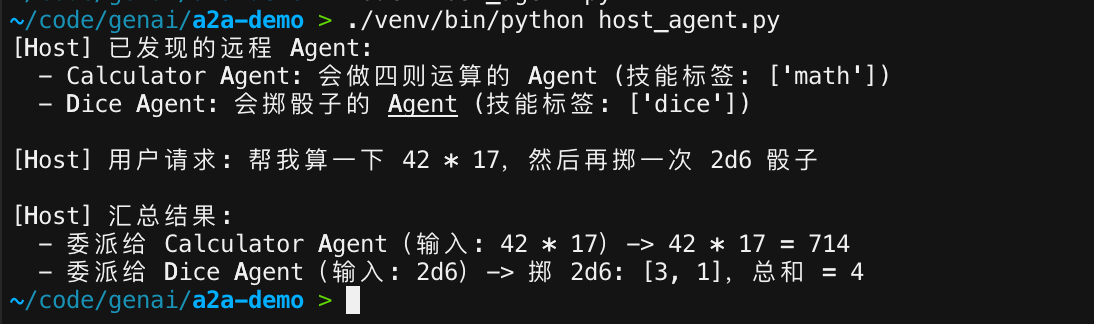
运行
./venv/bin/python remote_agents.py   # 终端 1:起两个远程 Agent
./venv/bin/python host_agent.py      # 终端 2:编排
A2A + MCP 组合架构
真实企业系统中两个协议各司其职:
                              用户
                               │
                               ▼
                     ┌──────────────────┐
                     │    Host Agent    │(LLM 编排:读 Card 做路由)
                     └───┬─────────┬────┘
               A2A(横向)│         │ A2A(横向)
                 ┌───────┘         └────────┐
                 ▼                          ▼
        ┌─────────────────┐       ┌─────────────────┐
        │  财务分析 Agent  │       │  行程规划 Agent  │
        │  (LangGraph)    │       │  (Google ADK)   │
        └───┬─────────┬───┘       └───┬─────────┬───┘
      MCP   │         │ MCP      MCP  │         │ MCP
   (纵向) ▼         ▼               ▼         ▼
      ┌────────┐ ┌─────────┐    ┌─────────┐ ┌──────────┐
      │ 数据库  │ │ 报表API  │    │ 航班API │ │ 日历服务  │
      └────────┘ └─────────┘    └─────────┘ └──────────┘
-
A2A 连接 Agent(横向):发现、委派、多轮协作、状态跟踪;
-
MCP 连接工具(纵向):每个 Agent 内部用 MCP 调自己的工具;
总结
A2A什么现在值得关注:
- 行业标准,不站队:Google 发起、Linux Foundation 中立治理,微软(Azure AI Foundry)、AWS、SAP、Salesforce 等均已表态支持,规范已到 v1.0;
- 保护投资:各团队可继续用自己的框架(LangGraph/ADK/CrewAI…),只要对外讲 A2A 就能互通,避免 N×N 定制集成;
- 企业级设计:复用 OAuth2 等现有安全体系;“不透明执行"保证跨部门/跨公司协作时不泄露内部提示词、数据和工具;
- 与 MCP 互补:MCP 管 Agent 用工具,A2A 管 Agent 找同事,两个标准拼出完整的企业 Agent 架构;
- 落地成本低:百行 Python 即可让现有服务具备 A2A 能力。